10.1. Introduction
A filter of impulse response h(k) is bounded-input, bounded-output (BIBO) stable when a bounded input signal x(k) produces a bounded output y(k).
Let us consider a bounded input signal x(k);
| (10.1) | 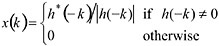 |
where h*( ? k) and h( ? k) respectively designate the conjugate and the complex modulus of h( ?k). With equation (10.1), the output y(k) is written as:
| (10.2) | 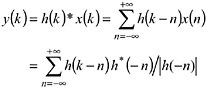 |
More specifically, equation (10.2) verifies for k=0:
| (10.3) | 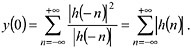 |
If the filter is BIBO stable, then it verifies the following condition:
| (10.4) |  |
Inversely, if the impulse response h(k) of the filter satisfies equation (10.4) then, for any input signal x(k) bounded by M, the output y(k) verifies:
| (10.5) |  |
Let us assume now that the filter admits a transfer function [1]:
| (10.6) |  |
We write C the open convergence ring (i.e. circular band) represented as:
| (10.7) |  |
or it can be represented as:
| (10.8) |  |
or as:
| (10.9) |  |
or as:
| (10.10) |  |
and  is the closing of the convergence ring, obtained by replacing the strict inequalities by loose inequalities.
If the filter is BIBO stable, then the series of the general term h(k) converges and the unit circle:
| (10.11) |  |
is included in  . Inversely, if T ?C, then the filter is BIBO stable, since equation (10.4) is satisfied.
EXAMPLE 10.1. the impulse response filter represented as:
| (10.12) | 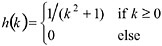 |
admits a transfer function H z (z) of the convergence ring  . We can see that the filter is BIBO...


 TABLE OF CONTENTS