Digital Filters Design for Signal and Image Processing
Chapter written by Mohamed NAJIM and Eric GRIVEL.
The study of discrete-time signals is based on the z-transform, which we will discuss in this chapter. Its properties make it very useful for studying linear, time-invariant systems.
This chapter is organized as follows. First, we will study discrete, invariant linear systems based on the z-transform, which plays a role similar to that of the Laplace transform in continuous systems. We will present the representation of this transform, as well as its main properties; then we will discuss the inverse-z-transform. From a given z-transform, we will present different methods of determining the corresponding discrete-time signal. Lastly, the concepts of transfer functions and difference equations will be covered. We also provide a table of z-transforms.
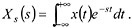
With analog systems, the Laplace transform X s (s) related to a continuous function x(t), is a function of a complex variable s and is represented by:
| (2.1) | |
This variable exists when the real part of the complex variable s satisfies the relation:
| (2.2) | |
with r= ? ? and R=+ ?, r and R potentially characterizing the existence of limits of X s (s).
The Laplace transform helps resolve the linear differential equations to constant coefficients by transforming them into algebraic products.
Similarly, we introduce the z-transform when studying discrete-time signals.
Let {x(k)} be a real sequence. The bilaterial or two-sided z-transform X z (z)