Digital Filters Design for Signal and Image Processing
Chapter written by Daniel BASTARD and Eric GRIVEL.
The synthesis of digital filters has benefited from research done with continuous-time filters. So, to make this text comprehensive, in this chapter we will start with a brief summary of continuous-filter synthesis, which is carried out using analog components such as resistances, inductances, condensers and even active components.
In this chapter, the main methods to design continuous-time filters are introduced and the different families of filters that have been developed are presented. We will first discuss Butterworth, Cauer and Chebyshev filters (these last of types I and II). The frequency responses of Type I (resp. Type II) Chebyshev low-pass filters exhibit ripple in the passband (resp. in the stopband). We also will discuss Bessel-Thomson and Papoulis filters.
The main points covered in this chapter will be taken up again in Chapter 6, which presents information on infinite impulse response digital filters.
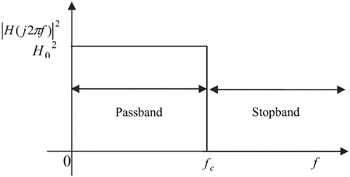
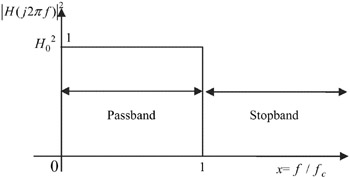
Let us consider the example of an ideal low-pass filter of normalized gain and whose frequency is in relation to cut-off frequency (see Figure 4.1).
With an ideal filter, transmission is total in the passband and the stopband.
We write x as the normalized frequency in relation to the cut-off frequency:
| (4.1) | |
NOTE. x is also called the normalized angular frequency in relation to the cut-off angular frequency: ![]()
In general, we...