11.4. Linear Predictive Coding
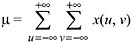
To conclude, we demonstrate an application for 2-D non-separable recursive filters. This is the method of linear predictive coding. Let us consider a 2-D signal x(u, v) with a bounded support and centered, for example, a gray level image with M rows and N columns (we show such an image below), such that the summation below, which has a finite number of non-null terms, is null:
If the above conditions do not apply, we must subtract the constant ?/ (MN) from each sample of x in order to have a centered signal.
It is important to reduce the redundancy of information between neighboring pixels. We can do this with a linear filtering operation: we look for a causal FIR filter, of transfer function:
where the order m and n are arbitrarily bounded, which, affected by the signal x(u, v), give as an output signal y(u, v), of minimal energy:
| (11.43) | 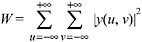 |
The filter being of finite impulse response and the input signal being of bounded support, the non-null terms are of finite number in the sum of equation (11.43).
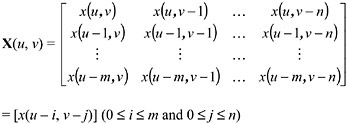
To calculate this optimum filter, we can proceed in the following way. We write A= [a h,k ] (0 ? h ? m and 0 ? k ? n) as the matrix of dimension ( m+1) ( n+1) containing the coefficients of the filter, and for  , we write:
the matrix of...


 TABLE OF CONTENTS