Digital Filters Design for Signal and Image Processing

11.6. Appendix B: Optimum 2-D Stability Criteria

11.6. Appendix B: Optimum 2-D Stability Criteria

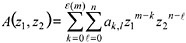
Let us consider a recursive filter of transfer function H(z) = B(z)/A(z) that is causal or semi-causal and without non-essential singularity of the second kind in the unit bi-circle T 2. We write:

(11.45)

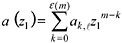
and

with:

(11.46)

In this section, we ask these question: how do we choose a criterion to test the stability of H(z)? Is there a criterion that is better adapted than the others for computer implementation?

To answer these questions, we will introduce the complexity degree of a 2-D stability criterion and show that certain criteria have a minimum degree of complexity.

We saw at the end of Chapter 10 that the resultant R (z 1 ) obtained by eliminating z 2 between the two polynomial equations in z 2 :

is a complex polynomial in the variables z 1 and whose coefficients depend on the coefficients of A(z 1 , z 2 ). Moreover, whatever the complex value of z 1 , the resultant R (z 1 ) only takes real values. Hence, it is also a real polynomial R(x, y)

of the variables x and y associated with the real and imaginary parts of z 1 respectively:

By dividing the polynomial R(x, y) by y 2 + x 2 ?1 in the space of real polynomials in x and y, we obtain the equation:

(11.47)

Here T(x)

UNLIMITED FREE
ACCESS
TO THE WORLD'S BEST IDEAS

SUBMIT
Already a GlobalSpec user? Log in.

This is embarrasing...

An error occurred while processing the form. Please try again in a few minutes.

Customize Your GlobalSpec Experience

Category: Color Meters and Appearance Instruments
Finish!
Privacy Policy

This is embarrasing...

An error occurred while processing the form. Please try again in a few minutes.