Direct Strip Casting of Metals and Alloys: Processing, Microstructure and Properties

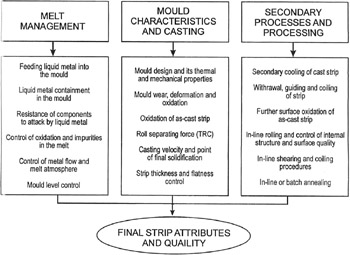
While not exhaustive, Table 4.1 provides a list of important factors that need to be considered in order to produce high quality, low-cost strip products. These factors may be divided into those that affect the melting, casting and downstream processing stages.
|
![]() |
This section considers the introduction of molten metal into the mould from various holding furnaces and its containment in the mould during casting.
An important factor affecting strip surface quality in vertical TRC is the control of the height of the melt pool (Cramb 1995; Guthrie and Tavares 1998; Blejde et al. 2000b; Zapuskalov 2003). Variations in pool height ( h ? h) affect the metallostatic pressure of the melt since ? P = ? g ? h. The flow of liquid metal into the mould must therefore be extremely consistent to maintain a constant metallostatic pressure and, hence, contact pressure between the strip and the mould wall. This generates a uniform interfacial heat flux throughout casting and alleviates problems with variations in strip thickness and surface quality (Cramb 1988, 1995). Other factors affecting cast strip quality include surface waves and variations in fluid flow patterns in the mould due to general pool turbulence (see 4.3.2.3). Internal pool dams are an effective method for suppressing wave formation, as well as stabilising the meniscus and minimising contact between any inclusions...