Direct Strip Casting of Metals and Alloys: Processing, Microstructure and Properties

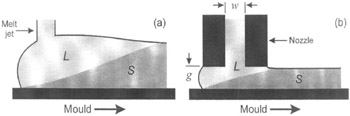
In casters of the types shown schematically in Figures 3.16a-c, molten metal is introduced onto a rotating belt or roll to produce the as-cast strip. As indicated in 3.2.4, these processes have been used extensively in the production of rapidly-quenched ribbons in a continuous manner since the invention by Pond and Maddin (1969) of the rotating substrate method for producing amorphous alloy strip. The liquid/solid front in chill block melt spinning and planar flow casting are shown schematically in Figure 4.11; both processes are characterised by the flow of liquid metal onto a moving substrate with the planar flow casting process generating flow by a pouring nozzle with a special lip profile. Here, the bottom of the tip is located a short distance, g (<< 1 mm) from the roll surface. In the solidification process, it is necessary to ensure adequate heat extraction while maintaining the melt puddle until solidification of the strip is complete.
The nucleation and growth of grains during chill block melt spinning can be summarised as follows (van Rooijen et al. 1985):
For metals that crystallize during casting, heterogeneous nucleation is expected to occur predominantly at the meniscus region on the substrate side of the flowing melt to generate a very fine grained structure.
The nuclei that form will produce...