Direct Strip Casting of Metals and Alloys: Processing, Microstructure and Properties

During strip casting, the molten metal solidifies by losing heat through the interface between the solidifying strip and the rolls, belts or stationary walls of the caster. The interface is important as it affects both the heat flux during solidification and the nucleation and growth behaviour of solidifying grains at the melt/substrate interface as well as markedly influencing strip quality (Cramb 1995; Wang and Matthys 1996; Strezov and Herbertson 1998; Blejde et al. 2000a,b). This section outlines the principal modes of interfacial heat transfer and some of the more important factors affecting heat flux in DSC.
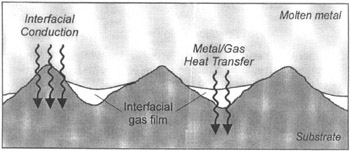
When molten metal is brought into contact with the wall of a mould, the magnitude of the interfacial heat flux is determined by the temperature difference between the two surfaces and the interface resistance to heat flow (Flemings 1974). During solidification, latent heat is also released at the moving solid-liquid interface (Eq. 2.20) with the major impediments to its removal being the solidifying metal itself, the metal/mould interface and the mould. Figure 4.25 is a schematic diagram of the interface region between a solidifying metal and the mould showing two possible modes of heat transfer: (i) heat flux through metal/mould and (ii) heat flux through metal/gas regions.
Conduction heat transfer The rate of heat flow by conduction is governed by the temperature...