Earth Retention Systems Handbook

In any situation involving a retaining wall or shoring structure, lateral loads exist. The applied loads may be the result of earth pressures, seismic loads, surcharge loads, or hydrostatic pressures. But, whatever their source, they are constantly trying to push the wall over and must be restrained. The restraint can be developed from inside the excavation or outside. Commonly used methods are few in number but many in their variations.
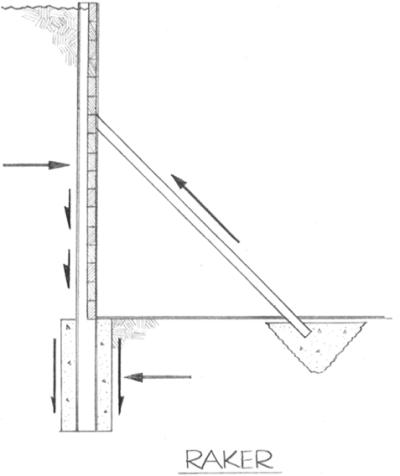
Rakers are sloping compression units that derive their capacity inside the excavation (see Figure 4.1). They are attached to the wall and braced against either the structure being constructed, or a footing specifically cast for the purpose of resisting the raker forces. Since rakers are sloping elements, they impart not only a lateral force to the wall to counteract the applied load, but also an uplift force. This uplift force is counteracted by friction, either above the base of the excavation or below the excavation if the wall has a toe element (that portion of the wall which extends below the base of the excavation).
Struts are another bracing type which function from within the excavation. Struts are horizontal compression units which attach to the wall normal to the imposed lateral load (see Figure 4.2). Struts are braced against either an existing structure or another portion of the shoring system. Because the strut is applying a horizontal force at right angles to the wall, uplift loads are not a concern.