Earth Retention Systems Handbook

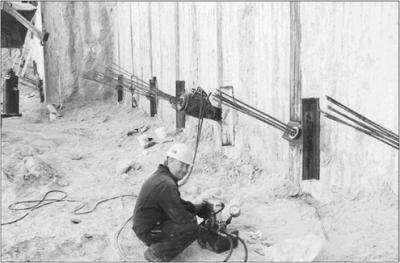
Anchored earth retention is probably one of the most tightly tested and confirmed systems available in geotechnical engineering. After the geotechnical engineer has characterized the soils and the designer has selected and designed the shoring system, the anchoring is subjected to an intense battery of tests. The design assumptions for the anchor length and installation method are tested through a series of verification tests. Once the design assumptions are confirmed, the actual installation of the anchors is rigorously tested. Through a system of performance tests, confirmation is obtained that the agreed assumptions are still in force. Then, regular proof tests are performed on the remainder of the anchors to ensure that quality is being maintained. In the end, every anchor on the project should have been tested in one fashion or another (Figure 14.1).
In order to begin soil or rock anchor design, an initial assumption of capacity must be made. This assumption is then tested through a process called verification testing which is used to test the soil/grout interface. The verification test is not used to test the grout/ tendon interface because it is well understood and not subject to job specific differences. Similarly, the verification does not test the tendon strength. Extensive regular material testing by manufacturers of anchor tendons and their components is performed prior to the sale of the tendons. Verification anchors are usually installed as sacrificial anchors...