5.4 PLANE STRAIN
The incompatibility of strain that arises in the plane potential formulation involving the function A 0 (x, y) can be satisfied by adopting a different approach.
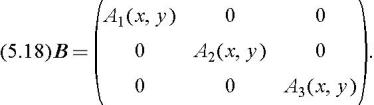
Consider the Beltrami potential tensor in the form
The Beltrami potential formulation of this form is sometimes referred to as the Maxwell stress potential.
Compute the stress tensor and note that the resulting stress state is no longer planar.
<b class="bold">B := {{A1[x, y], 0, 0}, {0, A2[x, y], 0}, {0, 0, A3 [x, y]}}</b><b class="bold">B // MatrixForm</b><b class="bold">Stress := Inc [B]</b><b class="bold">Stress // MatrixForm</b> Find the strain tensor and compute the incompatibility tensor II
<b class="bold">SS = IsotropicCompliance[nu]</b><b class="bold">Strain := Simplify[DDot[SS, Stress]]</b><b class="bold">(Strain) // MatrixForm</b><b class="bold">II := Inc [Strain]</b><b class="bold">(II) // MatrixForm</b>
Let us now consider the structure of the nonzero components of this tensor:
We note that the first four components can be made identically zero by setting
Under the same substitution, component II[[3, 3]] assumes the form
We conclude that biharmonicity of A 3 (x, y) ensures strain compatibility under this formulation.
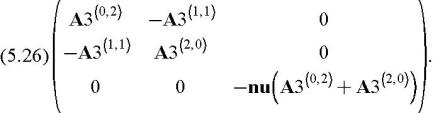
The stress tensor is now found in the form
<b class="bold">Stress // MatrixForm</b>
Note that the out-of-plane stress component is now present.
The strain state is now found.
<b class="bold">Simplify[Strain] // MatrixForm</b>
We note that this compatible strain state is indeed planar. Moreover, the above equation can be rewritten in the form
By comparison with equation (5.9), we note that the two expressions for strain in terms of the potential function (and hence...


 TABLE OF CONTENTS