5.6 BIHARMONIC FUNCTIONS
The above analysis of the plane problem demonstrates the important role played by biharmonic functions in the solution of elastic plane problems.
The general form of the solution of the biharmonic equation in two dimensions has been established by Goursat using the apparatus of functions of the complex variable ?=x+iy=r exp i ?. The general solution is found in the forms
where  and ? are arbitrary analytic (and therefore harmonic) functions of ?. The function ? above therefore describes the subset of biharmonic functions that are also harmonic, whereas the form
  represents the set of functions that in this context could be termed essentially biharmonic.
Without constructing a rigorous proof (which can be found, for example, in Muskhelishvili (1953)) one may remark that in the complex plane ?
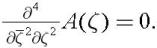
Therefore the biharmonic equation is
Considering ? and ? as two independent variables and integrating twice with respect to ? results in
where ?, ? 1 are analytic functions of ?. Further integration in ? preserves harmonicity and leads to the solution A( ?)=A 1 ( ?)+i A 2 ( ?) in the form of equation (5.31).
The convenience offered by the Goursat form (5.31) is that the complex variable ? can be expressed in terms of an arbitrary pair of coordinates in the complex plane, leading to a great variety of forms of solution.
The solution of the biharmonic...

 TABLE OF CONTENTS