Electric Machinery and Transformers, Third Edition

4.11: The Constant-Current Transformer

4.11 The Constant-Current Transformer

Thus far we have devoted our attention to the study of constant-potential transformers, for which the load voltage is essentially constant and the current varies with the load. A transformer of this type is designed to operate at or just above the knee of the magnetization curve in order to ensure relatively high permeability and low initial cost. The two windings are wound on top of each other to reduce the leakage fluxes.

A constant-current transformer, on the other hand, is designed to satisfy the constant-current requirement while the voltage drop varies with the load. In other words, the secondary voltage varies directly with the load in a constant-current transformer.

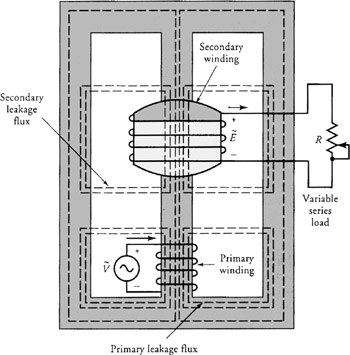
Figure 4.46 is an illustration of a constant-current transformer with a fixed primary winding and a moveable secondary winding. The transformer is designed to operate at a relatively high flux density so that the core is highly saturated. A saturated core assures low permeability which, in turn, implies high leakage flux.


Figure 4.46: A constant-current transformer feeding a variable resistive load.

The constant-current transformer operates on the principles that (a) a current-carrying coil manifests itself as an electromagnet and (b) like polarity poles of a magnet exhibit a force of repulsion.

In a constant-current transformer, the current in the primary winding induces a current in the secondary winding such that the mmf produced by one winding opposes the mmf of the other. In other words, at any instant, the two coils act like electromagnets with like...

UNLIMITED FREE
ACCESS
TO THE WORLD'S BEST IDEAS

SUBMIT
Already a GlobalSpec user? Log in.

This is embarrasing...

An error occurred while processing the form. Please try again in a few minutes.

Customize Your GlobalSpec Experience

Category: Single Phase Transformers
Finish!
Privacy Policy

This is embarrasing...

An error occurred while processing the form. Please try again in a few minutes.