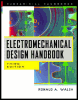
Electromechanical Design Handbook, Third Edition
Chapter 5: Strength of Materials

OVERVIEW

Strength of materials, as it is used in this discussion, concerns the relationship between external forces applied to materials and the strains or deformations that occur as a result of these forces.

We will apply principles and equations outlined in this section along with those taken from the chapters on mechanics and machine elements to the design of structures, mechanisms, parts, and machines.

5.1 COMMON TERMS USED IN STRENGTH OF MATERIALS

Cold flow
The gradual extrusion or deformation of a nonelastic material under load. Materials such as lead, other soft metals, and some plastics like Teflon exhibit cold flow under load. Some compensation must be made in design for this condition, such as spring loading the parts.
Damping or elastic hysteresis
When tensile loads are applied to a body, complete elongation is not produced immediately, but is accompanied by a time lag that depends on the material type and the magnitude of the applied stresses. When the tensile load is removed, complete recovery of energy does not occur. This effect is known as elastic hysteresis, or, for vibrating stresses, damping. This occurs within the proportional limit of the material.
Ductility
The ability of a material to be drawn into wire form.
Elastic limit
The maximum stress that may be applied to a material that then returns to its original dimensions. The elastic limit and the proportional limit for steels may be taken as the same point for practical purposes.
Elasticity
The ability of a material to...

UNLIMITED FREE
ACCESS
TO THE WORLD'S BEST IDEAS

SUBMIT
Already a GlobalSpec user? Log in.

This is embarrasing...

An error occurred while processing the form. Please try again in a few minutes.

Customize Your GlobalSpec Experience

Category: Metal Strip
Finish!
Privacy Policy

This is embarrasing...

An error occurred while processing the form. Please try again in a few minutes.