Electromechanical Design Handbook, Third Edition

Pneumatics is the study of air and gases and the relationship between volume, pressure, and temperature of the air or gas. To begin the discussion, let us define the normal condition of atmospheric air as follows:
At the reference conditions shown, the weight of atmospheric air is as follows:
| Temperature | 32 F (0 C) |
| Atmospheric pressure | 29.92 in of mercury (Hg), by barometer (14.7 psi at sea level); 760 mm Hg |
| Weight | 0.08073 1b/ft 3; 1 lb of air occupies 12.387 ft 3 at the listed temperature and pressure |
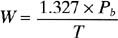
Then, the weight of 1 ft 3 of air at any other pressure and temperature is
where
W = weight, lb/ft 3
P b = barometric pressure, in Hg
T = absolute temperature, rankines ( R) (absolute 0 in rankine= ?459.69 F; see Secs. 1.13 and 1.14 in Chap. 1)
The relationship between pressure, volume, and temperature may be expressed as
where
P=absolute pressure, lb/ft 2
V=volume in ft 3 of 1 lb of air at the given temperature and pressure
T=absolute temperature, R
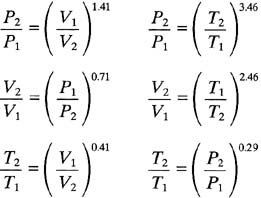
Adiabatic compression or expansion of air takes place without the transmission of heat to or from the air during the compression or expansion. The relations between P, V, and T are given by the following series of equations:

These equations are valid for both the U.S. customary and SI...