Electronic Applications of the Smith Chart: In Waveguide, Circuit, and Component Analysis
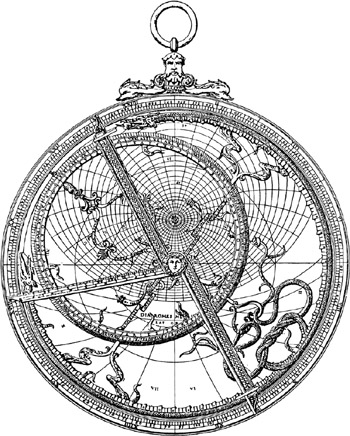
The physical laws governing natural phenomena can generally be represented either mathematically or graphically. Usually the more complex the law the more useful is its graphical representation. For example, a simple physical relationship such as that expressed by Ohm's law does not require a graphical representation for its comprehension or use, whereas laws of spherical geometry which must be applied in solving navigational problems may be sufficiently complicated to justify the use of charts for their more rapid evaluation. The ancient astrolabe, a Renaissance version of which is shown in Fig. I.1, provides an interesting example of a chart which was used by mariners and astronomers for over 20 centuries, even though the mathematics was well understood.
The laws governing the propagation of electromagnetic waves along transmission lines are basically simple; however, their mathematical representation and application involves hyperbolic and exponential functions (see Appendix A) which are not readily evaluated without the aid of charts or tables. Hence these physical phenomena lend themselves quite naturally to graphical representation.
Tables of hyperbolic functions published by A. E. Kennelly [3] in 1914 simplified the mathematical evaluation of problems relating to guided wave propagation in that period, but did not carry the solutions completely into the graphical realm.
The progenitor of the circular transmission line chart was rectangular in shape. The original rectangular...