Electronic Applications of the Smith Chart: In Waveguide, Circuit, and Component Analysis
Numerous attempts have been made to find a simpler grid [125] than that of the SMITH CHART on which waveguide transmission and reflection functions could be displayed. This chapter presents one solution to the problem which does not alter the basic SMITH CHART coordinates and which because of its inherent simplicity has certain practical advantages.
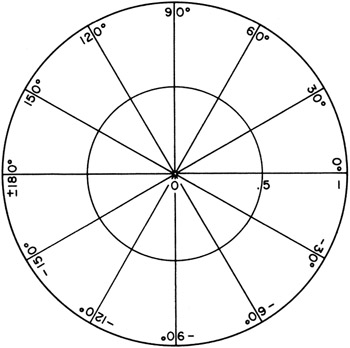
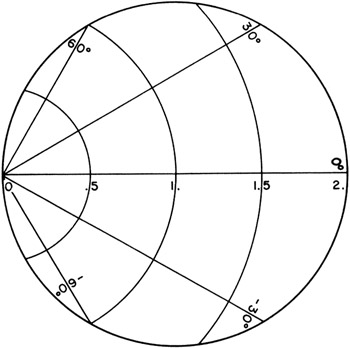
Polar coordinates are generally chosen to graphically portray the voltage and current reflection and transmission coefficients along a waveguide as shown in Figs. 8.1 and 8.2, and as described more fully in Chaps. 3 and 5, respectively. Their component values (magnitude and phase) are directly related to the voltage and current at any position along a standing wave which can readily be observed and measured. Accordingly, they have a well-defined physical significance. It is not the purpose of this chapter to depreciate the polar coordinate representation of these coefficients since this is extremely useful, but rather to show how an alternative rectangular coordinate representation can offer simplifications and advantages in some applications. This chapter will also show how the transmission coefficient components (both polar and rectangular) can be represented on the SMITH CHART in a manner which will not obscure the basic impedance or admittance coordinates with additional superimposed curves.
Any vector can, of course, be graphically represented on either polar or rectangular coordinates. For the...