Electronic Applications of the Smith Chart: In Waveguide, Circuit, and Component Analysis
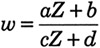
As will be shown herein, a conformal transformation can be applied to the curves on the rectangular transmission line chart in Fig. 1.2 in order to obtain the more convenient circular form shown in Fig. 1.3. When the latter figure is rotated 90 counterclockwise from the orientation shown (see Sec. 1.4), the transformation whose general form is
| (B-1) | |
will be found to give the desired result. By assigning the proper values to the constants a, b, c, and d, the axis of X/ Z 0 may be transformed into a circle of any convenient radius, and the entire chart will then lie within this circle. Each of the circles corresponding to a particular value of D will become a diameter of the new boundary circle and all of the other circles or straight lines in the rectangular chart will become circles or arcs of circles in the circular chart.
In order to perform such a transformation let each point on the rectangular chart be denoted by a complex number
w = u + jv
where
and
Similarly let each point on the circular chart be denoted by
Z = x + jy
Then the following conditions may be set up: The u axis is to be transformed into a circle of radius A whose center lies on the y axis a distance A above the origin. At the same time, the point ( u