Electronic Applications of the Smith Chart: In Waveguide, Circuit, and Component Analysis
The accuracy which can be obtained in plotting and reading out data on the coordinates of the SMITH CHART, as with any other chart, can be improved by simply increasing its size to provide space for a finer and more expanded coordinate grid. Where it is impractical to increase the overall chart size to the desired extent, small regions of special interest may be enlarged as much as is desired.
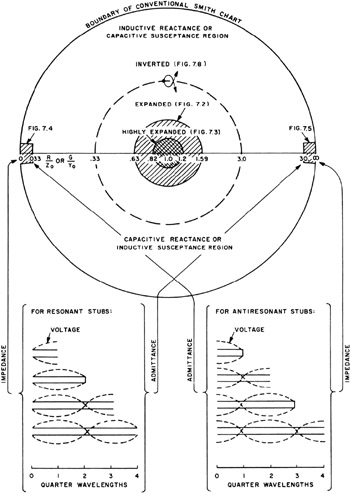
In this chapter, enlargements of the more frequently used regions (see Fig. 7.1) of the SMITH CHART will be presented and discussed, and special applications for these will be given. The graphical representation of the properties of stub sections of waveguide which are operated near their resonant or antiresonant frequency, as may be readily portrayed on two of these expanded charts, will be discussed in some detail.
The specific region on a SMITH CHART which is most commonly expanded is perhaps a circular region at its center concentric with its perimeter. This region, typically as shown in Fig. 7.2 or 7.3, is of special interest because it encompasses all possible input impedances, and equivalent admittances, along a waveguide when the load reflection coefficient or standing wave ratio is less than the value at the perimeter of the expanded central area. The expanded central portion of a SMITH CHART utilizes the same peripheral scales as the complete chart; all radial scales have the same value at the center...