Elementary Probability with Applications

There are many cases where an event can be decomposed into its components and the probability of this event can then be determined by applying the addition rule followed by the multiplication rule.
Example 3.1. Suppose the Mets and Cubs play a baseball doubleheader, and the Cubs are twice as likely to win any game as the Mets. Is a sweep more likely than a split?
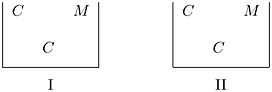
Solution: Let s construct an urn model for this situation. Urn I will represent the first game and will contain 2 C s and 1 M since the Cubs are twice as likely to win game 1 as the Mets. Urn II will represent the second game and have the same composition as Urn I. We now select one letter at random from each urn to correspond to an outcome for the doubleheader. A sweep would correspond to getting the same letter twice.

Let A denote the event that the Cubs win game I and B denote the event that the Cubs win game II. How would we write the event sweep in terms of A, B?
First, observe that not A and not B = Mets win doubleheader. Thus, we could write out the decomposition of the event sweep as follows:
The two events connected by or are mutually exclusive so the addition rule applies giving:
Now we have two events connected by the word and in each term...