5.1 Counting Formula
In this section we develop the counting formula needed for Chapters 5 and 6.
Definition: Factorial n is denoted by n! and given by
for n a positive integer. So n! is the product of the first n positive integers where n is a positive integer. We define 0! = 1.
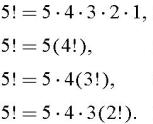
There are various ways of expressing a factorial. For example,
We can use this information in evaluating ratios of factorials. For example,
Important Note: For some of the material that follows, the computations are tedious. When this turns out to be the case, our objective will be to get an expression for the answer. Accordingly, the statement, Find an expression for means the answer should be given in terms of sums, products, quotients, factorials, powers, etc.
Example 5.1. A box contains three chips labelled A and two chips labelled B. All five chips are selected without replacement from the box. Think of every possible ordered selection as a word. How many words are there? We answer this question with the help of the multiplication rule.
Look at the word AABAB. The probability of drawing an A as the first letter is 3/5. The conditional probability that the second letter is A given that the first letter is A is 2/4. If the first two letters are A, there is one chip labelled A and two chips labelled B

 TABLE OF CONTENTS