Elementary Probability with Applications
3.4: Bayes Formula

3.4 Bayes Formula

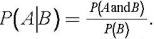
Whenever we have a situation where we know P( B A) and we want to find the probability with the events reversed, P( A B), then Bayes formula can be applied. The credit for the discovery of this formula is given to Thomas Bayes, a Presbyterian minister in England who was interested in mathematics. The derivation involves using the multiplication rule twice. The objective is to find P( A B). The first application of the multiplication rule gives


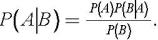
The second application of the multiplication rule gives


The last equation is known as Bayes formula. It gives P( A B) in terms of P( B A) . To evaluate the denominator P( B) in this equation, we will need to decompose B and then use both the addition and multiplication rules.

Keep in mind that there is a difference between P( A B) and P( B A). For example, if A denotes the set of college students and B denotes the set of single people, then P( A B) is the proportion of single people who are college students (less than .5) whereas P( B A) is the proportion of college students who are single (much larger than .5).

Consider another example of the difference between P( A B) and P

UNLIMITED FREE
ACCESS
TO THE WORLD'S BEST IDEAS

SUBMIT
Already a GlobalSpec user? Log in.

This is embarrasing...

An error occurred while processing the form. Please try again in a few minutes.

Customize Your GlobalSpec Experience

Category: Diodes
Finish!
Privacy Policy

This is embarrasing...

An error occurred while processing the form. Please try again in a few minutes.