Elementary Probability with Applications
A graphical method for solving problems in this chapter uses a horizontal tree.
Example 3.9. A probability class has two girls ( G) and four boys ( B). Two students are selected at random without replacement. Find P(2nd student selected is a girl) = P(2nd is G).
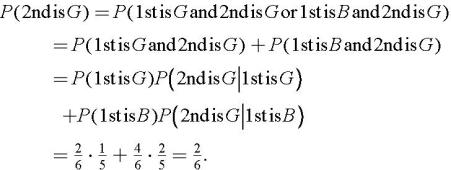
Using the method of Section 3.1, we first decompose the event 2nd is G :
So
An interesting thing to note here is that P(1st is G) = P(2nd is G) even though the selections are made without replacement. At first sight this seems surprising. But
is an unconditional probability referring to the long-run proportion of times that the 2nd is a G whereas
is a conditional probability referring to the long-run proportion of times the 2nd is a G but looking only at those cases where the 1st is a G. P(2nd is G) considers the situation where the first student has been selected but no information regarding the sex of that student has been determined. So it is the same as if the first student had not been selected.
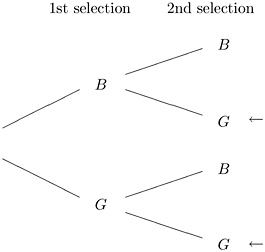
Next we find P(2nd is G) using a (horizontal) tree:

The horizontal tree gives a graphical representation of all possible outcome paths. In this problem there are four possible outcome paths where each path represents one of the mutually exclusive and exhaustive outcomes ( B,B) , ( B,G