Elementary Probability with Applications

Cryptology is the science which deals with the coding and decoding of secret messages. Probability plays an important role in cryptology. In this section, we examine some fundamental concepts of cryptology.
In English-language text, the 26 letters in the alphabet appear with the following relative frequencies:
| A | 7.3% |
| B | 0.9% |
| C | 3.0% |
| D | 4.4% |
| E | 13.0% |
| F | 2.8% |
| G | 1.6% |
| H | 3.5% |
| I | 7.4% |
| J | 0.2% |
| K | 0.3% |
| L | 3.5% |
| M | 2.5% |
| N | 7.8% |
| O | 7.4% |
| P | 2.7% |
| Q | 0.3% |
| R | 7.7% |
| S | 6.3% |
| T | 9.3% |
| U | 2.7% |
| V | 1.3% |
| W | 1.6% |
| X | 0.5% |
| Y | 1.9% |
| Z | 0.1% |
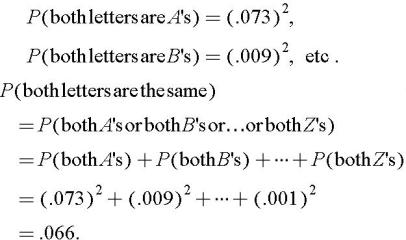
We see that some letters occur much more frequently than others. The letter E occurs more frequently than the other letters. Suppose that two letters are selected from English-language text. From the relative frequency listing,
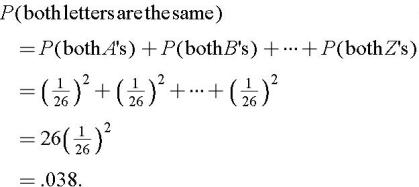
Now suppose we have a language with the same 26 letters but where all 26 letters are equally likely. Select two letters at random from that language.
Summarizing,
We can estimate P(2 letters are the same) for a given message by looking at the corresponding proportion. This is the same method we use to estimate the probability of...