Engineering Design Communication and Modeling Using Unigraphics NX

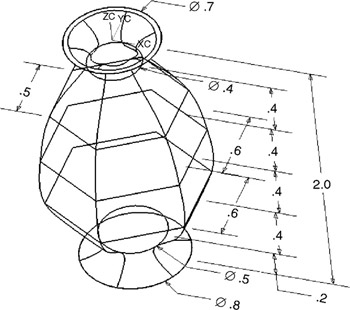
Use the modeling methods learned from this chapter to model the following vase:
Model a Joukowski airfoil with the following data:
| No. | x-coordinate | y-coordinate |
|---|---|---|
| 1 | 1.9730 | 0.0102 |
| 2 | 1.8953 | 0.0701 |
| 3 | 1.7070 | 0.1329 |
| 4 | 1.4211 | 0.1916 |
| 5 | 1.0547 | 0.2390 |
| 6 | 0.6288 | 0.2694 |
| 7 | 0.1669 | 0.2795 |
| 8 | -0.3054 | 0.2682 |
| 9 | -0.7620 | 0.2376 |
| 10 | -1.1767 | 0.1922 |
| 11 | -1.5246 | 0.1383 |
| 12 | -1.7832 | 0.0828 |
| 13 | -1.9340 | 0.0321 |
| 14 | -1.9637 | -0.0092 |
| 15 | -1.8664 | -0.0393 |
| 16 | -1.6446 | -0.0589 |
| 17 | -1.3105 | -0.0711 |
| 18 | -0.8855 | -0.0798 |
| 19 | -0.3993 | -0.0882 |
| 20 | 0.1134 | -0.0971 |
| 21 | 0.6159 | -0.1049 |
| 22 | 1.0736 | -0.1078 |
| 23 | 1.4571 | -0.1011 |
| 24 | 1.7436 | -0.0811 |
| 25 | 1.9185 | -0.0461 |
| 26 | 1.9746 | 0.0029 |
Scale the profile to 40% of its original size and use the scaled one as the tip profile. Model a Joukowski Airfoil with these two profiles. (Hint: You may need to create a spine and two guide strings to assist the modeling.)
Model a base circle cam with al diameter using the fol-lowing data:
| No. | x-coordinate | y-coordinate |
|---|---|---|
| 1 | 1.0000 | 1.0000 |
| 2 | 0.9738 | 1.0487 |
| 3 | 0.9453 | 1.0949 |
| 4 | 0.9149 | 1.1383 |
| 5 | 0.8827 | 1.1789 |
| 6 | 0.8491 | 1.2168 |
| 7 | 0.8142 | 1.2519 |
| 8 | 0.7783 | 1.2841 |
| 9 | 0.7417 | 1.3136 |
| 10 | 0.7046 | 1.3404 |
| 11 | 0.6672 | 1.3645 |
| 12 | 0.6297 | 1.3861 |
| 13 | 0.5923 | 1.4052 |
| 14 | 0.5552 | 1.4221 |
| 15 | 0.5185 | 1.4367 |
| 16 | 0.4823 | 1.4493 |
| 17 | 0.4468 | 1.4601 |
| 18 | 0.4121 | 1.4691 |
| 19 | 0.3781 | 1.4765 |
| 20 | 0.3451 | 1.4826 |
| 21 | 0.3130 | 1.4874 |
| 22 | 0.2818 | 1.4912 |
| 23 | 0.2515 | 1.4941 |
| 24 | 0.2221 | 1.4962 |
| 25 | 0.1935 | 1.4977 |
| 26 | 0.1657 | 1.4987 |
| 27 |