Engineering Design Communication and Modeling Using Unigraphics NX

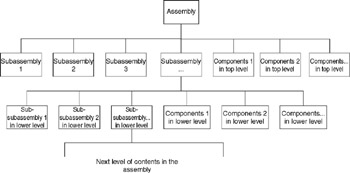
Individual components are the elements that compose machines. The purpose of engineering assembly modeling is to insert these components in a specific sequence and spatial position so they can perform the desired functions. In engineering design, when the design models are formed by more than one component, they are called assembly models. The design assembly models are built according to: (1) function, (2) spatial position, (3) sequence of insertion, (4) shape, and other specific categories. Normally, the final assembly models have intermediate units, which are called subassemblies. Depending upon the sophistication of the design models, multi-level subassemblies are common practice (Figure 12-1). Regardless of whether subassemblies belong directly to the main assembly or to another subassembly, they are normally called a "subassembly."
In this chapter, we will introduce the concepts of engineering design assembly, design methodologies, applications of different design methodologies, and methods to assemble engineering design models.
Upon completing this chapter, you will be able to:
Understand basic engineering design modeling methodologies
Understand the problems that will result in various design failures
Identify principles and methods establishing relationships commonly used in machine assembly modeling
Identify constraints that limit unwanted degrees of freedom in an assembly model
Engineering Design Communication and Modeling Using Unigraphics NX
Manage multilevel design assemblies
Create assembly models with patterned component placement
The design methods discussed in previous chapters involve individual machine components. Component design is only a...