Ethernet Passive Optical Networks
Clearly addressing efficiency, performance, and implementation issues, this book provides valuable, annotated insights into all engineering-critical EPON topics.
 TABLE OF CONTENTS
 The IEEE 802.3 standard defines two basic modes of operation for an Ethernet network. In one configuration, it can be deployed over a shared medium using the carrier-sense multiple access with collision detection (CSMA/CD) protocol. In the other configuration, stations may be connected through a switch using full-duplex point-to-point links. Correspondingly, Ethernet MAC can operate in one of two modes: CSMA/CD mode or full-duplex mode.
Properties of the EPON medium are such that it cannot be considered either a shared medium or a point-to-point network; rather, it is a combination of both. It has a connectivity of a shared medium in the downstream direction, and it behaves as a point-to-point medium in the upstream direction.
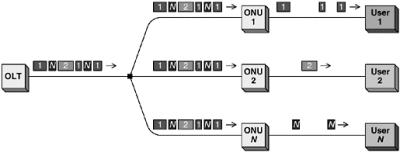
In the downstream direction, Ethernet packets transmitted by the OLT pass through a 1 N passive splitter or cascade of splitters and reach each ONU. The value of N is typically between 4 and 64 (limited by the available optical power budget). This behavior is similar to a shared-medium network. Because Ethernet is broadcasting by nature, in the downstream direction (from network to user) it fits perfectly with the Ethernet PON architecture: Packets are broadcast by the OLT and selectively extracted by their destination ONU (Fig. 5.1).
In the upstream direction...