Ethernet Passive Optical Networks

Clearly addressing efficiency, performance, and implementation issues, this book provides valuable, annotated insights into all engineering-critical EPON topics.
 TABLE OF CONTENTS
 Not being constrained by distance and bandwidth limitations of copper outside plant, EPON is able to deliver tens to hundreds of megabytes per second to and from users. A giant step forward compared to cable modems and DSL technologies, EPON is expected to be a truly converged network, supporting voice communications, standard and high-definition television (STV and HDTV), videoconferencing (interactive video), real-time and near-real-time transactions, and data traffic. To support this multitude of applications, EPON must guarantee appropriate performance for each such application.
Performance of a packet-based network (and EPON in particular) can be conveniently characterized by several parameters: bandwidth, packet delay (latency), delay variation (jitter), and packet-loss ratio. Quality of service (QoS) refers to a network s ability to provide bounds on some of or all these parameters on a per-connection (flow, session) basis. Not all networks, however, can maintain a per-connection state or even identify connections. To support diverse application requirements, such networks segregate all the traffic into a limited number of classes and provide differentiated service for each class. Such networks are said to maintain classes of service (CoS).
In this chapter, we focus on how to provide CoS differentiation mechanisms in EPON. These mechanisms include intra-ONU scheduling and inter-ONU scheduling, as shown in Fig. 16.1.
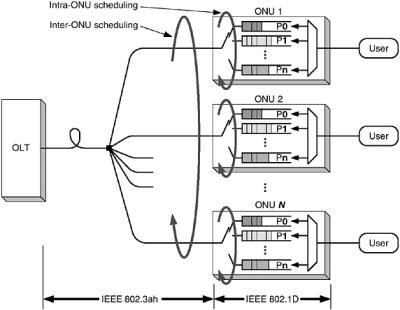
Being part of the IEEE 802 family of standards, EPON must be compliant with bridging defined in IEEE 802.1D [802.1D], including compliance with CoS mechanisms in this standard. Specifically,...