Ethernet Passive Optical Networks

Clearly addressing efficiency, performance, and implementation issues, this book provides valuable, annotated insights into all engineering-critical EPON topics.
 TABLE OF CONTENTS
 In this chapter, we investigate the performance of EPON with a static slot assignment (SSA). Specifically, we investigate how the static (fixed) slot structure can be combined with highly bursty data traffic consisting of variable-length Ethernet frames. We shall try to answer these questions in this study: What is the average delay the packets will experience in the ONU buffer? How big should this buffer be? And what link utilization can we achieve?
To obtain an accurate and realistic performance analysis, it is important to simulate the system behavior with appropriate traffic injected into the system. There are studies showing that most network traffic flows, such as http, ftp, and video streams, can be characterized by self- similarity and long-range dependence (LRD) (see App. A).
The simulation analysis was performed using synthetic self-similar traffic. Self-similar (or fractal) traffic has the same or similar degree of burstiness observed at a wide range of time scales. The method to generate self-similar synthetic traffic is described in App. B.
Let us consider an EPON segment consisting of an OLT and N ONUs (Fig. 14.1). The distances between the OLT and each ONU are randomly (uniformly) distributed over the interval [0.5 km, 20 km], which corresponds to round-trip times ranging from 5 to 200 s.
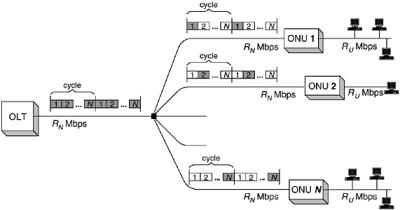
The transmission speed of the EPON and that of the user access link need not necessarily be the same. In...