Ethernet Passive Optical Networks

Clearly addressing efficiency, performance, and implementation issues, this book provides valuable, annotated insights into all engineering-critical EPON topics.
 TABLE OF CONTENTS
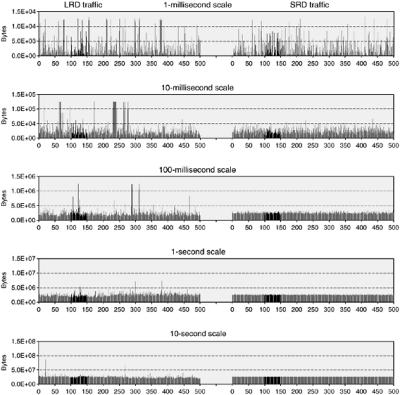
 There is an extensive study showing that most network traffic flows [i.e., generated by http, ftp, variable-bit-rate (VBR) video applications, etc.] can be characterized by self-similarity and long-range dependence (LRD) (see [WTE96] for an extensive reference list).
Figure A.1 illustrates the scaling behavior of LRD traffic in comparison with that of a short-range dependent (SRD) traffic such as the one based on the Poisson process.
Consider a cumulative process Y( t) with stationary increments, and let X t be its incremental process:
| (A.1) |  |
For example, Y( t) can represent the number of bytes arriving up to time t, and X t can represent the number of bytes arriving in 1 unit of time.
The proces  is an aggregated process of X t if
| (A.2) |  |
Process X t is said to be self-similar if X t is indistinguishable from  . This is a very restrictive definition, especially considering the stochastic nature of the network traffic. Usually, second-order self-similarity is considered for the purposes of traffic description: autocovariance functions of the original and aggregated processes should have the same values.
Let
| (A.3) |  |
and
| (A.4) |  |
Then the process X t is exactly second-order self-similar if
| (A.5) | 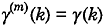 |
and asymptotically second-order self-similar if
| (A.6) | 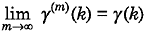 |
A convenient measure of a process s distributional self-similarity is its Hurst parameter H. A process is self-similar with parameter H (0 < H