Finite Elements: Theory, Fast Solvers, and Applications in Elasticity Theory

3. Further Tools from Functional Analysis

3. Further Tools from Functional Analysis

In Ch. II the existence of solutions to the variational problem was established using the Lax Milgram theorem. There the symmetry and the ellipticity of the bilinear form a( , ) were essential hypotheses. In order to treat saddle point problems, we need a more general approach which does not require that the quadratic form be positive definite.

The relation of the functional ? to the right-hand side f of the differential equation was discussed only briefly in Remark II.4.1. A more advanced consideration of linear functionals on Sobolev spaces is appropriate here. It leads us to the so-called negative norms.

Negative Norms

Let V be a Hilbert space. By the Riesz representation theorem, every continuous linear functional ? ? V ? can be identified with an element from V itself. Thus, often it is not necessary to distinguish between V and V ?. However, in the variational calculus, this can obscure certain important aspects of the problem. Before discussing methods of functional analysis, we first orient ourselves with a simple example.

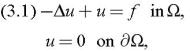
Consider the Helmholtz equation


with f ? L 2( ?). The weak solution is characterized by


where ( , ) 1 is the scalar product on the Hilbert space H 1( ?). The problem (3.1) can thus be formulated as follows: Given f, find the Riesz representation for the functional


If we identify with its dual, then there is nothing...

UNLIMITED FREE
ACCESS
TO THE WORLD'S BEST IDEAS

SUBMIT
Already a GlobalSpec user? Log in.

This is embarrasing...

An error occurred while processing the form. Please try again in a few minutes.

Customize Your GlobalSpec Experience

Category: Oxidation Reduction Potential (ORP) Instruments
Finish!
Privacy Policy

This is embarrasing...

An error occurred while processing the form. Please try again in a few minutes.