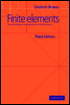
Finite Elements: Theory, Fast Solvers, and Applications in Elasticity Theory
The discretization of boundary-value problems leads to very large systems of equations which often involve several thousand unknowns. The systems are particularly large for three-dimensional problems and for problems of higher order. Often the bandwidth of the matrices is so large that the classical Gauss elimination algorithm and its modern variants are not efficient methods. This suggests that even for linear problems, we should use iterative methods.
Iterative methods first became popular at the end of the fifties, primarily as a means for solving large problems using computers with a small memory. The methods developed then are no longer competitive, but they still provide useful ingredients for modern iterative methods, and so we review them in 1. The bulk of this chapter is devoted to the conjugate gradient method which is particularly useful for the solution of variational problems and saddle point problems. Since the CG methods discussed here can be applied to a broad spectrum of problems, they are competitive with the still faster multigrid methods to be discussed later (whose implementation is generally more complicated and requires more individual programming).
We begin by classifying problems according to the number n of unknowns:
Small problems: For linear problems we can use a direct method. For nonlinear problems (e.g., using the Newton method), all elements of the Jacobi matrices should be computed (at least approximately).
Midsized problems: If the matrices are sparse, we should make use of this fact. For nonlinear problems (e.g., for quasi-Newton methods),...