Finite Elements: Theory, Fast Solvers, and Applications in Elasticity Theory

It frequently happens in practical problems that due to the nature of the data in certain subdomains, a solution of a boundary-value problem is less regular. In this case we would like to increase the accuracy of the finite element approximation without using too many additional degrees of freedom. One way to do this is to adaptively perform local grid refinement in those subdomains where it is needed. We first carry out the finite element calculations on a provisional grid, and then compute an a posteriori estimate for the error whose purpose is to indicate what part of the grid induces large errors. Using this information, we then locally refine the grid, and repeat the finite element computation. If necessary, the process can be repeated several times.
To simplify our discussion, we restrict ourselves to the case of the Poisson equation
with homogeneous Dirichlet boundary conditions. Moreover, we consider only conforming elements, although this still involves arguments which are usually associated with the analysis of nonconforming elements. This is why we have not presented a posteriori estimates earlier.
Let
be a shape-regular triangulation. In addition, suppose u h is a finite element solution lying in
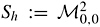
(or in
). Suppose ? h is the set of all inter-element boundaries, i.e., edges of the triangles T ?
which lie in the interior of ?.
If we insert u h into the differential equation in its...