Finite Elements: Theory, Fast Solvers, and Applications in Elasticity Theory

5. Mixed Methods for the Poisson Equation

5. Mixed Methods for the Poisson Equation

The treatment of the Poisson equation by mixed methods already elucidates some characteristic features and shows that saddle point formulations are not only useful for minimization problems with given constraints as in (4.1), (4.2). For example, there are two different pairs of spaces for which the saddle point problem is stable in the sense of Babu ka and Brezzi. It is interesting that different boundary conditions turn out to be natural conditions in the two cases.

The method, often called the dual mixed method, has been well established for a long time. On the other hand, the primal mixed method has recently attracted a lot of interest since it shows that mixed methods are often related to a softening of the energy functional and how elasticity problems with a small parameter can be treated in a robust way.

Moreover there are special results if X or M coincides with an L 2-space.

The Poisson Equation as a Mixed Problem

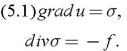
The Laplace equation or the Poisson equation ? u = div grad u = ? f can be written formally as the system


Let ? ? d. Then (5.1) leads directly to the following saddle point problem: Find such that


These equations can be treated in the general framework of saddle point problems with


The linear forms are continuous, and a is obviously L 2-elliptic. To check the inf-sup condition, we use Friedrichs inequality...

UNLIMITED FREE
ACCESS
TO THE WORLD'S BEST IDEAS

SUBMIT
Already a GlobalSpec user? Log in.

This is embarrasing...

An error occurred while processing the form. Please try again in a few minutes.

Customize Your GlobalSpec Experience

Category: Ion Exchange Resins
Finish!
Privacy Policy

This is embarrasing...

An error occurred while processing the form. Please try again in a few minutes.