Fundamentals of Power Electronics with MATLAB
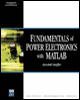
Designed as a hands-on reference, this text teaches students and engineers how to use MATLAB as a simulation and computational tool for power electronics.
 TABLE OF CONTENTS
 The principles of electrical energy and power are presented in the first chapter to lay a foundation for the study of the fundamentals of power electronics. Power Electronics is the subdiscipline of electrical engineering that involves electrical energy conversion by the control of semiconductor devices. The subject encompasses simple rectifier circuits to sophisticated motor control systems.
The energy and power principles lead to mathematical descriptions of the crucially important circuit qualities of power delivery and efficiency.
The subject of power electronics is the merger of the field of electrical power engineering and the technology of solid-state electronic devices. It is the discipline that involves the study, analysis, and design of circuits that convert electrical energy from one form to another.
Power electronic circuitry is needed because electrical devices require different forms of electricity. Some require an alternating current (AC) source, such as a transformer or AC motor; some require a direct current (DC) source, for example, the logic circuitry in a computer. When the appropriate form of electricity required by a device is not readily available, a power electronic circuit is needed to convert the available source into the form required by the device.
The study of power electronics begins with a review of the fundamental circuit laws and their application in the computation of electrical power.
The instantaneous voltage across a linear resistance is governed by Ohm's law:

The instantaneous current through