Fundamentals of Power Electronics with MATLAB
Designed as a hands-on reference, this text teaches students and engineers how to use MATLAB as a simulation and computational tool for power electronics.
 TABLE OF CONTENTS
 The DC-DC converter is an electrical circuit that transfers energy from a DC voltage source to a load. The energy is first transferred via electronic switches to energy storage devices and then subsequently switched from storage into the load. The switches are transistors and diodes; the storage devices are inductors and capacitors. This process of energy transfer results in an output voltage that is related to the input voltage by the duty ratios of the switches.
It is insightful and worthwhile to investigate why DC-DC converters are necessary before their detailed presentation and analysis. In addition to the constraints of size, weight, and cost, DC-DC converter technology also addresses the issues of efficiency and regulation.
Consider a power supply design problem in which 5 VDC at 4 A must be provided from a 12 VDC supply. One solution is to use a resistance to drop the 12 V down to 5 V. The required resistance is (12 5)/4=1.75 ?. The load resistance is 5/4=1.25 ?. The circuit is shown in Figure 4.1.
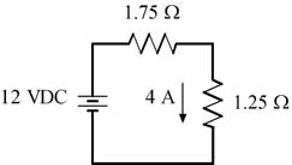
Two major issues are associated with the circuit in Figure 4.1. The first is efficiency. The power required by the load is (5)(4)=20 W; however, the power that must be supplied by the source is (12)(4)=48 W, which results in an efficiency of only 20/48 approximately 42%. The low efficiency is due to the power lost in the...