Fundamentals of Power Electronics with MATLAB
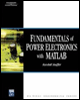
Designed as a hands-on reference, this text teaches students and engineers how to use MATLAB as a simulation and computational tool for power electronics.
 TABLE OF CONTENTS
 The electrical energy produced by utility companies is in the form of alternating current (AC) even though virtually all electronic systems require direct current (DC). The discrepancy arises for reasons of efficiency and economy: AC energy can be transformed to very high voltages that result in lower energy losses in the electrical distribution lines. The high voltage is then transformed again to a low AC voltage that is subsequently converted to DC by the rectifier circuit.
This chapter presents the theory and analysis of rectifier circuits. The method of analysis begins with a derivation of the instantaneous source current by the application of circuit laws. The analysis continues with the computation of the average load current, average load voltage, and average diode current. The average diode current is computed from the half-cycle average of the source current and determines the power dissipation in the device.
In the circuit analyses, the source voltage is assumed to be purely sinusoidal. The source current, however, is nonsinusoidal, and thus the power theory developed in Chapter 1 for nonlinear circuits is applicable. The analyses conclude with the numerical evaluations of RMS source current, the apparent, average, reactive, and distortive powers, and the power, displacement, and distortion factors. The results of the computations are followed by a discussion of possible power factor improvement. The study and analysis of rectifier circuits are essential because the rectifier is a key subcircuit...