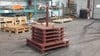
Force calibration equipment is needed to calibrate any of the force or load sensors described in chapter 4, section 4.7, "Force Transducers." The spans of load cells extend from a few tenths of a pound force to one million pounds force. Typical accuracies are from 0.02 to 0.1 percent of full scale. The large variation in load cell spans means that several pieces of calibration equipment would be required to cover all possible calibration requirements. The typical industrial load cell user will likely only have to calibrate a limited number of load cell ranges, those used in his or her plant. However, the test laboratory or calibration laboratory may have to purchase several calibration fixtures to cover a much wider range of load cell calibrations.
Load cells are calibrated either by applying a known force with weights or by using a hydraulic piston and a reference load standard. The load standard can be a high-accuracy load cell or a proving ring.
13.1 Dead-Weight Force Calibration
Dead-weight force calibration provides the most accurate results since it uses the fundamental unit of mass as a reference. The National Institute of Standards and Technology (NIST) uses six dead-weight calibrators to cover the range from 100 pounds force to 1,000,000 pounds force. The uncertainty is stated as 0.0005% of applied force. The overall uncertainty includes the uncertainties associated with the mass of the weights, the local acceleration due to gravity, and the determination of air density.
The air density is used to adjust the...
Copyright ISA—Instrumentation, Systems, and Automation Society 2006 under license agreement with Books24x7


 TABLE OF CONTENTS