Fundamentals of Test Measurement Instrumentation

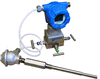
The types of velocity transducers discussed in this section use the piezoelectric, strain gauge, and electrodynamic methods of operation.
Velocity is a measure of how the displacement is changing with respect to time. Velocity is a vector quantity and thus has a magnitude and a direction. The speedometer in our car tells us how fast we are going but doesn't tell us in which direction. Speed is the magnitude of the velocity.
The units of velocity include inches per second and feet per second for linear velocity transducers and degrees per second or radians per second for rotary transducers.
Linear velocity transducers are used mainly to monitor vibration of rotating machinery such as motors, generators, and pumps.
Piezoelectric velocity transducers are piezoelectric accelerometers (see section 4.6.2) with built-in electronic integrators to provide an output that is proportional to velocity.
Strain gauge velocity transducers are strain gauge accelerometers (see section 4.6.3) with built-in electronic integrators to provide an output that is proportional to velocity.
Electrodynamic velocity transducers use the movement of a permanent magnet relative to a coil of wire to produce an output that is proportional to the velocity of the movement. In some designs, the magnet is mounted on a rod that moves through a hollow core around which the coil is wound. In other designs, the coil is suspended on springs and attached to a dampener within...