A Gallery of Fluid Motion

Containing a collection of some of the most striking photographs of fluid motions, this text also includes digitally generated visualizations from computational simulations of flow phenomena, and animated visualizations.
 TABLE OF CONTENTS
P. Koumoutsakos and A. Leonard
California Institute of Technology
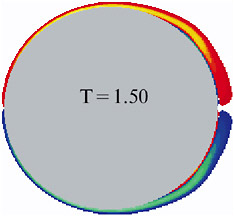
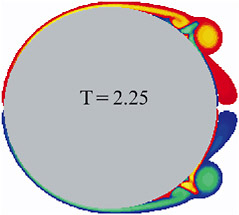
We conducted high resolution simulations of incompressible flow past an impulsively started cylinder at Re=2 UR/v=9500. We solve numerically the vorticity form of the Navier-Stokes equations using a novel implementation of vortex methods, including an accurate treatment of diffusion effects and the no-slip condition. [1] At the onset of the impulsive start a very thin layer of primary (negative on the upper part of the cylinder) vorticity resides around the cylinder as it is introduced by the initial potential flow. This layer thickens and flows inducing a layer of secondary (positive on the upper half of the domain) vorticity on the backside of the cylinder. At Ut/R= T ?1.5 a bulge of vorticity forms at ? ? 50 that is the signature of the unsteady separation. The secondary vorticity penetrates the feeding vortex sheet of the primary vortex at T ? 2.25, and reaches the outer flow. The primary vortex then rolls up and detaches eventually from the body carrying along a part of the secondary vortex. The separating shear layer continues to extract vorticity from the surface of the body and a regular pattern of vorticity extraction, penetration of the secondary vorticity to the outer layer, and subsequent suppression by the oncoming shear layer is established. This and vortex merging in the near wake results in the intricate vorticity patterns shown at later times.