A Gallery of Fluid Motion

Containing a collection of some of the most striking photographs of fluid motions, this text also includes digitally generated visualizations from computational simulations of flow phenomena, and animated visualizations.
 TABLE OF CONTENTS
Hiroshi Higuchi and H l ne Balligand
Syracuse University
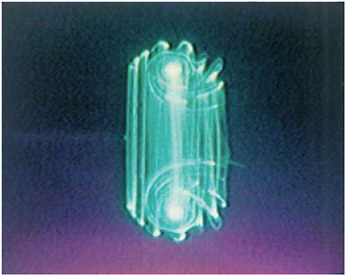
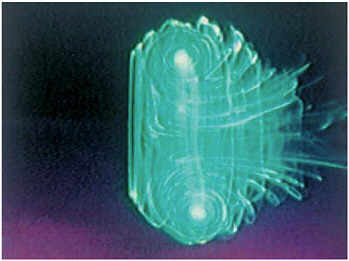
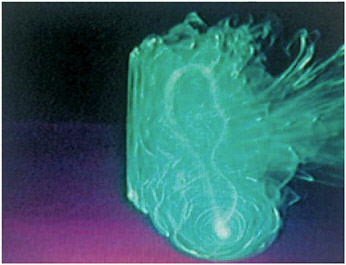
This work investigates the development and breakdown of the vortex structure behind a circular disk that is nearly impulsively started and subsequently moved at a constant speed. [1] Figure 1 shows an oblique view of the axisymmetric vortex that develops initially: this visualization is obtained by fluorescent dye and a UV light. In Fig. 2 the wake is illuminated only on its cross section by a laser light sheet where axisymmetric vortex roll-up and Helmholtz shear layer instability waves can be seen. With continued motion of the disk at the constant velocity, the vortex ring starts to tilt as the rear stagnation point moves off-center, as seen in a sequence of photographs [Figs. 3(a) 3(c)]. Here, a laser light sheet and a UV light are used simultane ously. The onset of three-dimensional structure is seen in Fig. 3(c). In Figs. 2 and 3, the acceleration rate, A p= D(dU/dt)  , is 3 and the Reynolds numbers based on model diameter, Re D, are 6200 and 4200, respectively ( A p=0.74, Re D=9300 for Fig. 1). Nondimensional time, T= U 0 t/D, is indicated in each figure.


| Keywords | fluorescent dye; UV-light; laser sheet; start-up vortex. |
[1]H. Higuchi, H. Balligand and J. H. Strickland, Numerical...