A Gallery of Fluid Motion

Containing a collection of some of the most striking photographs of fluid motions, this text also includes digitally generated visualizations from computational simulations of flow phenomena, and animated visualizations.
 TABLE OF CONTENTS
I. Aranson and D. Blair
Argonne National Laboratory
Peter Vorobieff
Los Alamos National Laboratory
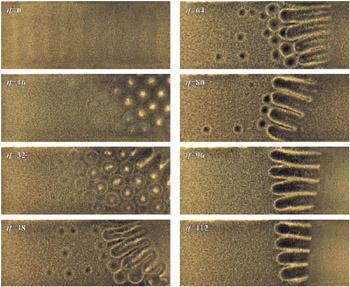
Granular materials are now recognized as a distinct state of matter, and studies of their behavior form a fascinating interdisciplinary branch of science. The intrinsic dissipative nature of the interactions between the constituent macro-scopic particles gives rise to several basic properties specific to granular substances, setting granular matter apart from the conventional gaseous, liquid, or solid states. [1]
Thin layers of granular materials subjected to vertical vibration exhibit a diversity of patterns. [2] The particular pattern is determined by the interplay between driving frequency f and the acceleration amplitude ?. Interfaces in vibrated granular layers, existing for large enough amplitude of vibration, separate large domains of flat layers oscillating with opposite phase. These two phases are related to the period-doubling character of the flat layer motion at large plate acceleration. Interfaces are either smooth or decorated by periodic undulations depending on parameters of vibration. [3] An additional subharmonic driving results in a controlled displacement of the interface with respect to the center of the experimental cell. [4] The speed and the direction of the interface motion are sensitive to the phase and amplitude of the subharmonic driving.
The image sequence above shows interface nucleation and propagation towards the center of the cell, with dimensionless time tf labeled in each image. The interface forms at the right side wall of the cell...