A Gallery of Fluid Motion

Containing a collection of some of the most striking photographs of fluid motions, this text also includes digitally generated visualizations from computational simulations of flow phenomena, and animated visualizations.
 TABLE OF CONTENTS
A. Prasad and C. H. K. Williamson
Cornell University
Despite the large body of research concerned with the near wake of a circular cylinder, the far wake, which extends beyond about 100 diameters downstream, is relatively unexplored, [1] , [2] especially at low Reynolds numbers. We have recently shown that the structure of the far wake is exquisitely sensitive to free-stream noise, and is precisely dependent on the frequency and scale of the near wake; indeed it is shown that the presence of extremely lowamplitude peaks in the free-stream spectrum, over a remarkably wide range of frequencies, are sufficient to trigger an oblique wave resonance in the far wake. [3] , [4] , [5]
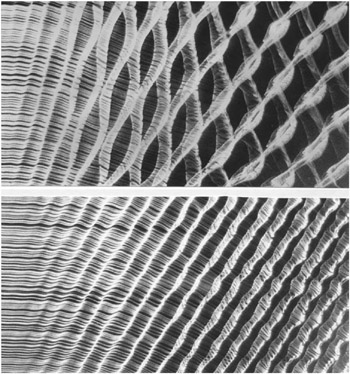
We show, in the upper photograph of Fig. 1, a nonlinear interaction between oblique shedding waves generated from upstream (to the left) and 2-D waves amplified downstream from free-stream disturbances (in the central region). We use the smoke-wire technique (placed 50 diameters down-stream), and the wake is viewed in planview, with flow to the right. This two-wave interaction triggers a third wave, namely an oblique resonance wave at a large oblique angle, to grow through nonlinear effects (in the right half of the photograph), in preference to the original two waves. If smoke is introduced 100 diameters downstream, in the lower photograph (under slightly different conditions), then all that is seen is a set of such large-angle oblique resonance waves.
This work is...