This chapter introduces geometric modeling in the context of the forces motivating and shaping its development, and tries to answer the question What is geometric modeling? The history of geometric modeling is itself growing in importance because of what it tells us about the interplay of theory and application, academia and industry, as well as ideas and personalities, perhaps suggesting ways of managing these forces more effectively. This chapter reviews the highlights of this history. The mathematics of geometric modeling spans the disciplines of differential geometry, linear and Boolean algebra, topology, and numerical methods, which are briefly discussed. Vectors and matrices are employed throughout the literature of geometric modeling, including this text, so this chapter thoroughly reviews their algebras and properties. It concludes with a summary of conventions and notation schemes.
1.1 What Is Geometric Modeling?
Geometric modeling evokes a curious mix of the visual and the analytic in the eyes and minds of those of us who study and apply it. The visual response arises from its association with the simulation of shapes that define objects in the real world, from its association with the potential reality of the designer s work, and from its symbiosis with computer graphics. The analytical response arises from an awareness of the elegant and often subtle mathematics that is its foundation.
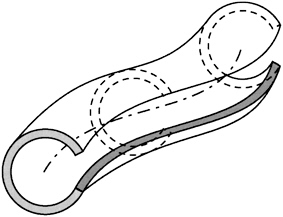 Figure 1.1: Geometric modeling.
 The term geometric modeling first came into use during the late 1960s and early 1970s, a time of rapidly developing computer graphics and computer-aided design and manufacturing technologies.
Copyright Industrial Press, Inc. 2006 under license agreement with Books24x7


 TABLE OF CONTENTS