Two families of cubic Hermite curves forming a parametric net are the basis of the bicubic Hermite surface. A simple tensor product produces the 16-term polynomial, to which boundary conditions are applied, generating the geometric form. Four corner points, together with two tangent vectors and a twist vector at each of these points, are the necessary and sufficient conditions defining the bicubic Hermite patch. Sixteen points, four of which are interior, are also sufficient. Reparameterizing, truncating, and subdividing a patch proceed in much the same way as for curves. A large complex surface can be defined by a composite collection of simpler patches, while preserving certain levels of continuity.
7.1 Algebraic and Geometric Forms
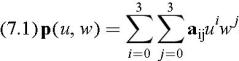
The algebraic form of a bicubic Hermite patch is given by the tensor product
where
The a ij vectors are the algebraic coefficients of the patch. The reason for the term bicubic is obvious, because both parametric variables are cubic terms if a 33 ?0. Notice that as with Hermite curves, the parametric variables u and w are usually restricted to values in the interval 0 to 1, inclusive. This makes the patch bounded in a regular way. We will discuss this restriction and the use of irregular boundaries later. The tensor product method allows us to describe a rectangular patch as a product of the curve-defining polynomials.
Expanding Equation 7.1 and arranging the a ij terms in descending order produces a result similar to Equation 3.2 for curves:
Copyright Industrial Press, Inc. 2006 under license agreement with Books24x7


 TABLE OF CONTENTS