Geometric Modeling, Third Edition

12.7: Intersections

12.7 Intersections

One of the most important computational tasks of modeling is determining whether or not two geometric objects intersect. If the objects do intersect, we must be able to mathematically describe the intersection. As the number and complexity of objects increases, the need for computational subtlety and complexity increases. This section begins with the simple problem of finding the points of intersection between a straight line and other geometric objects and concludes with the more subtle and complex problem of finding the curve of intersection between two surfaces.

Intersections with Straight Lines

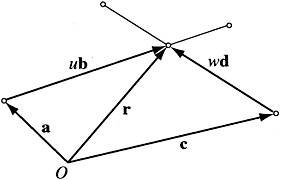
Two straight-line segments in three-dimensional space may intersect in two different ways if they intersect at all. They may intersect at a single point, as at r in Figure 12.36, or they may be collinear (that is, overlap either partially or completely).


Figure 12.36: Intersection of two straight lines.

Let one line be given by p (u) =a+ u b and the other by q (w)= c+ w d, where u, w ?[0, 1]. At their point of intersection p (u)= q (w)= r, or


Thus, we have three linear equations, one for each component or coordinate direction, and two unknowns, u and w. The system is clearly over constrained. Solve for u and w using two of the equations, say, a y+ ub y= c y+ wd y . Then use the third equation to verify the results. Finally,...

UNLIMITED FREE
ACCESS
TO THE WORLD'S BEST IDEAS

SUBMIT
Already a GlobalSpec user? Log in.

This is embarrasing...

An error occurred while processing the form. Please try again in a few minutes.

Customize Your GlobalSpec Experience

Category: Scissor Lifts
Finish!
Privacy Policy

This is embarrasing...

An error occurred while processing the form. Please try again in a few minutes.