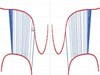
Curves are often defined as the locus of a point moving with one degree of freedom. Another definition describes a curve as the locus of a one-parameter family of points. History records many variations on the idea of a curve as a path of one dimension, having length only. Such definitions may help us to visualize a curve and to improve our intuitive sense of its behavior, but they are not explicitly analytical. Of more importance to geometric modeling is that these definitions lead to useful analytical expressions. Ways to mathematically describe curves for geometric modeling include intrinsic equations, explicit and implicit equations, and parametric equations. The latter category is expressed powerfully in the Hermite, B zier, and B-spline forms. Each of these forms is discussed in detail in Chapter 3, 4, and 5, respectively. This chapter reviews and compares these methods for representing curves. Specific differential properties of curves, including the moving trihedron, curvature and torsion are discussed in detail in Chapter 12.
2.1 Intrinsic Equations of Curves
An intrinsic property is one that depends on only the figure in question, and not its relation to a coordinate system or other external frame of reference. The fact that a rectangle has four equal angles is intrinsic to the rectangle, but the fact that a particular rectangle has two vertical sides is extrinsic, because an external frame of reference is required to determine which direction is vertical.
Intrinsic descriptions of a figure are easy to construct and understand. Imagine that you...
Copyright Industrial Press, Inc. 2006 under license agreement with Books24x7


 TABLE OF CONTENTS