Geometric Modeling, Third Edition

The algebraic description of a curve as a set of parametric cubic polynomial equations and their corresponding vector equation begin this chapter. We see that expressing the algebraic coefficients in terms of boundary conditions leads directly to the more convenient geometric form. The Hermite basis functions emerge as the mathematical link between the algebraic and geometric forms. We then find that both forms are expressed concisely as matrix equations, which prove useful when converting between Hermite and B zier basis functions as well as in other transformation operations. Varying the magnitude of the tangent vectors offers a way to modify the interior shape of a curve without changing the position of the endpoints or the Cartesian slopes at these points. Truncating and subdividing a curve is accomplished by reparameterizing the basis functions and adjusting certain curve boundary conditions. Additional refinements of the Hermite form allow a curve to interpolate three or four given points. Some conic curves are represented exactly by a Hermite curve, while others are closely approximated. Finally, in this chapter we see that Hermite curve segments joined end-to-end form a composite curve, and if certain continuity conditions are met, it will have the properties of a spline.
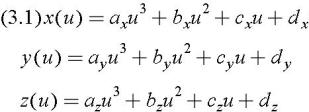
The algebraic form of a parametric cubic curve is given by the following three polynomials:
We usually restrict the parameter u to values in the interval 0 to 1, inclusive, or u ? [0, 1]. This restriction bounds the curve, creating a curve...