Grid Computing for Electromagnetics

Supported with 110+ illustrations, this cutting-edge book clearly describes a high-performance, low-cost method to solving huge numerical electromagnetics problems.
 TABLE OF CONTENTS
 In this chapter we give practical guidelines to building up a grid and to using its facilities. For the sake of clarity, the chapter refers to a simple yet realistic grid, as shown in Figure 3.1.
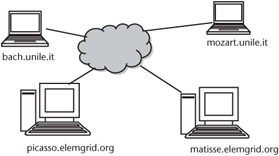
The grid represented in the figure is composed of four machines interconnected by a transfer control protocol/Internet protocol (TCP/IP) network. Each machine is identified by its FQDN (i.e., the combination of its hostname plus its domain name). The four FQDNs are: "picasso.elemgrid.org," "matisse.elemgrid.org," "mozart.unile.it," and "bach.unile.it." The commands and the installation process are relative to the version 2.2 of the GT, and it is assumed that the machines are equipped with the RedHat Linux version 7.2 operating system, so each command is referred to this operating system. More on the Linux operating system and its commands can be found in Appendix A.
Though the description of the GT installation procedure might be more or less substantially adapted to different versions of the tool (and of the operating system), we try here to evince the main conceptual steps of the procedure and their general aspects, rather than proposing a simple "recipe" stuck to a specific code and system version. Consequently, we hope that the conceptual relevance of the proposed discussion remains valid even when different versions of the toolkit or of the Linux operating system...