Grid Computing for Electromagnetics

Supported with 110+ illustrations, this cutting-edge book clearly describes a high-performance, low-cost method to solving huge numerical electromagnetics problems.
 TABLE OF CONTENTS
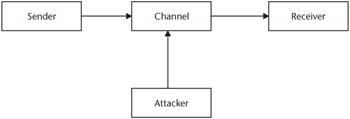
 When exchanging data through a network, a number of entities are involved:
The sender (i.e., the party who sends the message);
The receiver (i.e., the party to whom the message is addressed);
The channel (i.e., the medium transporting messages from the sender to the destination).
The Internet is an example of a channel. It is an open and public channel (i.e., its technology is adherent to well-known international standards, and anybody can use it). Internet openness is one of the main causes of its strength and wide penetration, even though this implies some drawbacks as well. The most critical is security: when a message travels through Internet nodes and cables, anybody may intercept it and eventually modify its contents (Figure B.1). A number of freely downloadable tools exist that allow anybody to "sniff" packets traveling in the network and eventually alter their data.
Cryptography, a very old science dating back to Egyptian pharaohs age, provides algorithms and techniques to hide information and to tunnel it straight to the legitimate receiver. Cryptography algorithms are nowadays used to manage the most common security requirements: confidentiality, authentication, and data integrity. Confidentiality